Humility in the Epidemic of Overconfidence
Skepticism in the Sea of Bad Ideas
I have proudly waved the Generalist flag for most of my career, which is often met with a resounding "Meh." Generalist have tried many ways of describing themselves to sound appealing: Jack-Of-All-Trades, Multi-Disciplinarian, or Polymath. More often Generalists sound like someone who does nothing well: Amateur, Hobbyist, or Non-Expert.
The skillset is hard to describe, but there is no shortage of evidence showing that Generalists are more likely to innovate and disrupt, better at forecasting outcomes in ambiguity, and less likely to be fooled by overconfidence.
Generalists like me are overlooked because our broad knowledge results in Emergent Abilities which are hard to measure.
Complex systems cannot be summarized by adding up the characteristics of their components, they exhibit emergent properties or behaviors which their components do not have on their own. It's difficult to grapple with interactions which you cannot understand through reductionist cause and effect, so we gloss over it or seek causation where none exists.
Likewise, it is impossible to summarize a Generalist's abilities by analyzing the components of our career. Our abilities emerge from our breadth of knowledge the way that beauty emerges from art, you cannot measure beauty by analyzing the paint.
Confidence is a powerful tool for making progress. We perceive confidence as a sign of knowledge and expertise. Confident people are more likely to get hired, elected, and raise money. They speak the most in groups and probably make more friends.
There's one big problem: confident people most likely do not know what they're talking about. Because humans are plagued by overconfidence.
Two concepts can help us understand the epidemic of overconfidence:
- The Dunning-Kruger Effect (DK): Novices are prone to the confidence of thin competence because people who don't know much, don't know enough to know how little they know. There are far more novices than experts in the world, which means when you meet a confident person you're most likely seeing the confidence of thin competence.
- Nobel Disease: Experts are prone to overconfidence because we regularly elevate them and ask them to opine on topics outside of their expertise, assuming expert chemists have expert opinions on geopolitics. The consequence is supercharged confirmation bias, which has led a startling number of Nobel Prize winners to adopt irrational or unscientific views from ghosts to eugenics.
The reality is that most work today involves Wicked Problems (worth reading if this is new to you). Wicked problems are complex problems with ambiguous rules and no single solution. No single solution means no single expert, and if confidence is derived from expertise then we have very little reason to be confident. The world is increasingly interdisciplinary and we will spend most of our time working in domains outside of our expertise.
This is a good time to have a Generalist's background.
When I write about humility in Generalists I specifically mean intellectual humility, the opposite of overconfidence. This is the humility of knowledge and ideas, the willingness to admit that what we think might not be right.
Dunning-Kruger helps show why humility emerges in Generalists. We follow a frustrating cycle of knowledge acquisition, collecting the trough of Dunning-Kruger by figuring out how little we know in a domain before moving on to the next topic. But pay attention to how far down the knowledge axis the trough sits, it can take a lot of work to get to the bottom. Some of My Troughs took years to reach.
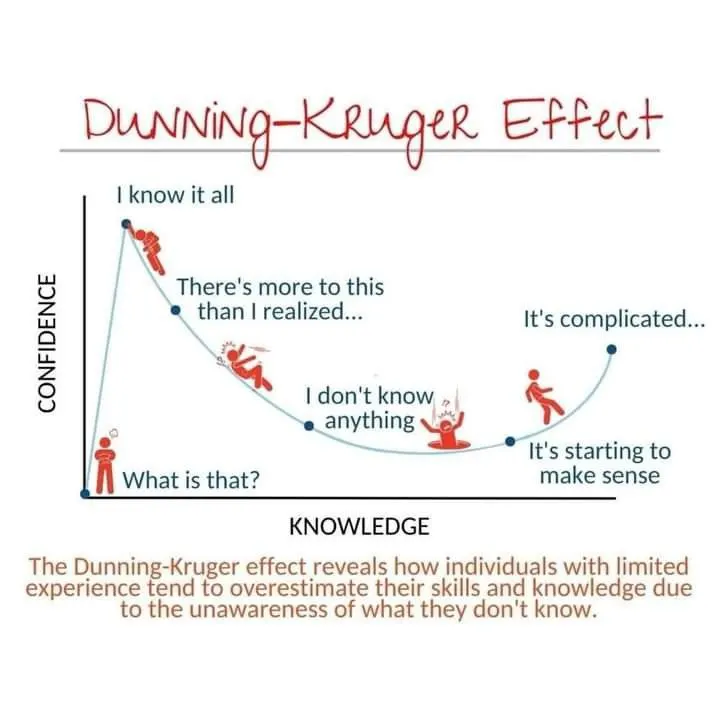
With this description we can be brutally clear about what I think a generalist is, trigger warning if your LinkedIn tagline uses the word polymath. A Generalist is not a person who knows a lot about everything. The world has pushed us to lean into "a jack of all trades" and casually leave out the whole "master of none" part. Unfortunately for us Generalists, our sales pitch isn't great:
A Generalist is someone who knows enough in many domains to know how little they know.
I will say it again, you have to know quite a bit to recognize how little you know. That knowledge is very useful for getting things done, but the real value of a Generalist's intellectual humility is more interesting, we know what we can't do.
There are two things we can do because we know what we can't do:
- See through the confidence of thin competence and call bullshit on unrealistic ideas
- Know when we need a real expert and effectively communicate with them
At least that's what I think, but I hardly know anything...
Collecting troughs as a Generalist can be emotionally challenging. Some Dunning-Kruger visuals call the low point "The Valley of Despair." We can become very cynical if we fall into analysis paralysis and are unable to take action with imperfect information. We can also suffer from supercharged impostor syndrome when we constantly feel like we know nothing. Ironically, being a Generalist requires a different kind of confidence: confidence in ourself.
It is hard to walk into a room constantly feeling like we know nothing while others parade around with their overconfidence.

But if we can maintain humility and optimism in this state, we can aggregate knowledge from diverse people and resources in a way that others cannot!
We become like chameleons... Scratch that, we're so much more than lizards. We become like Gandalf 🧙, assuming different identities in different contexts. We have worn many hats (jobs) and speak many languages (domains).
Our humility emerges from being broadly learned across many domains. You cannot achieve this without reaching the bottom of the Dunning-Kruger trough and recognizing that confidence is most often misplaced.
Armed with our humility and the courage to embrace it, we Generalists become excellent filters of bad ideas. This is more important than you might understand. Because, as we will explore next, most ideas fail.
- p. 282
- Thinking, Fast and SlowDaniel Kahnemanp. 212
- quoted


